Introduction
We will explore the scientific method and how it has been able to advance our understanding of the natural world in the last several centuries through passing of the method from teacher to student to teacher as Neil deGrasse Tyson has described in the Cosmos.
The idea broadly is cycle of
- Observation: Making observations about the natural world.
- Hypothesis: Form an explanation for these observations.
- Experiment: Test the hypothesis through experiments to find evidence for or against the hypothesis.
- Conclusion: Draw conclusions based on the experimental results and refine the hypothesis as needed.
Interestingly enough, deductive reasoning is considered as different from scientific method. Deductive reasoning involves conclusion based on the premises like axioms/assumptions. While scientific method is considered to be broader in scope.
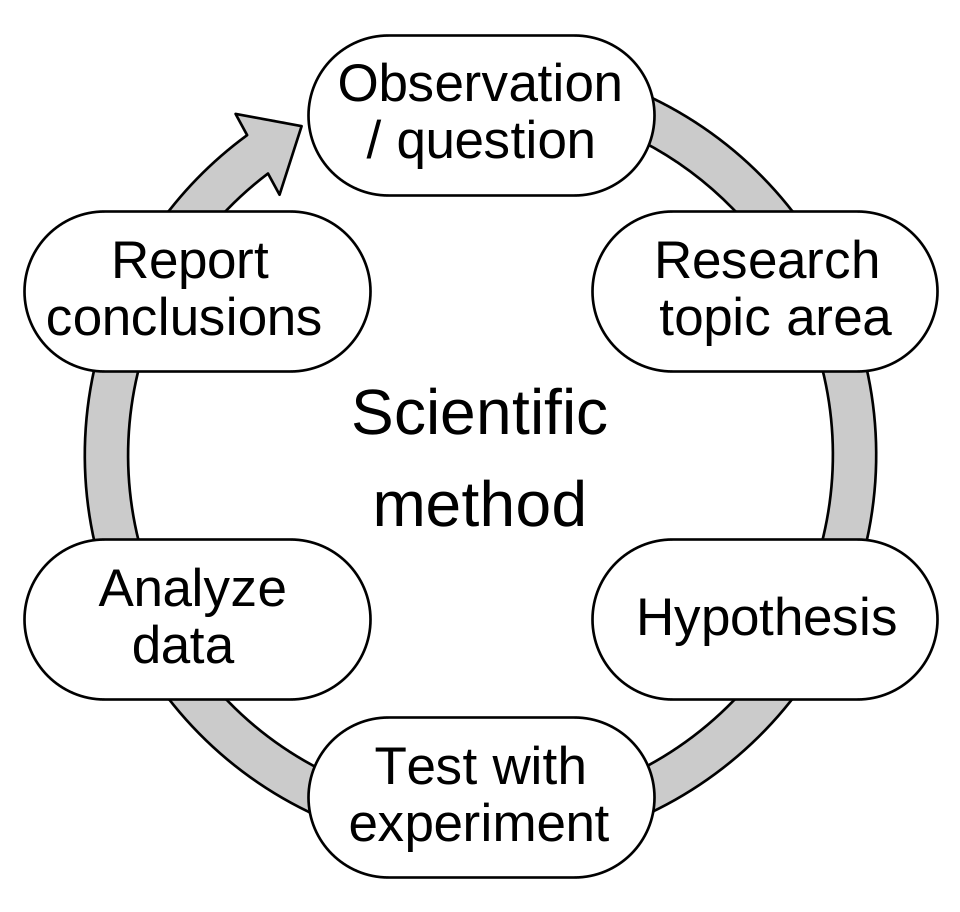
Wikipedia: The Scientific Method
The Royal Society, founded in 1660, has been a key institution in promoting the scientific method and encouraging empirical research with many key figures as members like Isaac Newton, Robert Hooke, and Edmund Halley. Their motto is Nullius in verba, often translated as “take nobody’s word for it,” captures an important spirit of science: claims should ultimately be tested against evidence, not accepted solely on the basis of authority. In this sense, science encourages us to “see for ourselves” by questioning assumptions, examining evidence, and remaining open to revision.
Science lives at the boundary between what we know and what we do not yet understand. It is acceptable, and often necessary, to admit uncertainty. What matters is that we continue asking questions, testing ideas, and refining our understanding rather than pretending that our current knowledge is complete.
Open to revision is essential as new information becomes available and our understanding evolves. It's important to reevaluate our conclusions as new evidence emerges or assumptions change.
Other than freedom of expression, ability to question authority, science also requires environment of open exchange of ideas to flourish for the larger community to which the understanding belongs.